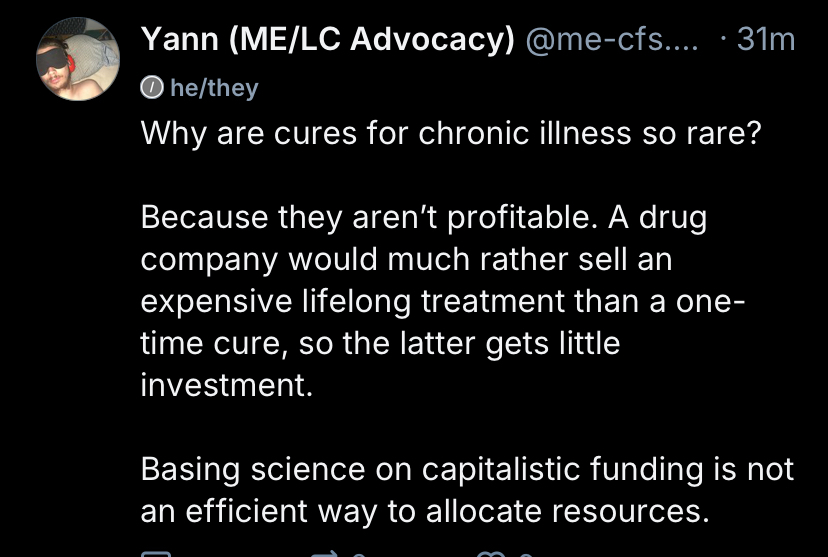
Or, chronic diseases which have been effectively cured aren’t considered chronic diseases anymore?
Stop with your logic on the Internet!
And yes, the vast majority of the apparatus that is capitalism is evil, before anyone wants to think I’m simping for it.
Hell, most chronic disease cures are done by the evil and completely untrustworthy propaganda machine that is the government.
Yeah, we’ve cured a ton of previously chronic diseases. I don’t know what planet these people live on. We’ve even effectively cured certain cancers in our lifetimes, and more will come. It’s also just much harder to cure something than treat something.
I’m really struggling to think of any, most coming to mind are bacterial or viral, though I’m certain there are thousands of chronic human pathologies we’ve cured, some we probably don’t even remember curing because the terminology is so outdated (though sadly dropsy is still a thing, and frustratingly consumption isn’t eradicated yet …but it could be!)
Can you give me a starting point if you’ve got one on your tongue? I’d like to journey down the Wikipedia rabbit hole tonight!
hidradenitis suppurativa
edit: i read wrong, that’s uncured, i could imagine that along with what you mentioned, a lot are likely nutrition-based, treatments have gotten better for a lot of things, outlooks and lifespans for certain genetic conditions, but off the top of my head i can’t think of anything that has a “cure” that’s not viral or environmental
There’s surgical interventions that cure a lot of things, like certain kinds of blindness, or pretty much anything that requires a transplant.
With two prospective diabetes cures moving towards human trials, I hope there will be a more compelling answer in 10 years or so, but that’s TBD.
Myopia (shortsightedness) is a fairly big one.
The cure’s been so ingrained that the anti-medicine/eugenics people don’t think about their own glasses when posting.
You can just go get your eyes tested, some glasses fitted, and you’re done. Repeat if it gets worse.
If you want something more permanent, you can get someone to slice open your eye, blast it a bit with a laser, and in theory, you would be completely cured, as if you never needed glasses.
Lasik is a great example, thank you!
Though I wouldn’t put glasses in the same category because it’s not a cure, it’s a medical device to correct the medical issue and it requires you to use the device for the rest of your life, if you stop using the device your symptoms immediately return, that’s not a cure. Glasses are the equivalent of insulin for diabetes. It’s treatment, not cure, without it, the disease takes full effect, but with it, yes you will be functionally cured as long as you have your glasses/insulin available, but even when functionally cured, you will always be a person with low vision/diabetes and always need ongoing treatment…until there’s a “cure”.
If my poor vision was cured by getting glasses I wouldn’t be squinting while I’m typing this in size 18 font (my glasses are in the other room and I’m too lazy to get them), and I wouldn’t suddenly be completely disabled by my lack of vision when it rains (glasses need to come with windscreen wipers! I can’t see shit in the rain)
Ahh… The ol’ “What do you call alternative medicine that works?”-aroo.
This is such a lie. This only works if you assume no other people will ever develop one of those illnesses. Even if all acquired illnesses are ever eradicated, big pharma companies will still make bank off hygiene products, makeup, and Aspirin. Pharma companies don’t just sell treatments and cures. Duh.
Because chronic diseases are difficult to cure? A solid portion, like diabetes, or cancer, are a whole host of different causes in a costume.
Anything that can be easily cured/trivially managed, or outright prevented isn’t considered a chronic disease any more. Beri-beri and Scurvy are non-issues today. Diabetes and AIDS aren’t the death sentences they used to be.
Medical research being deliberately gatekept because a cure would be unprofitable is conspiratorial thinking, and isn’t really reflective of reality.
A single dose cure for a chronic illness would be huge, and a lot of places would throw money at one if it existed, even if the cost was several orders of magnitude higher. No insurance, public health scheme, nor medical clinic would want a patient to take a constant course of medication, when they could have one, and be done. It’d be better for them, and patient quality of life. Even for the medication companies, they get to be in history books, and can get instant income, where a long term scheme might have patients dropping off for one reason or another.
And if someone cures it first that’s it, they win the whole pot until generics are approved.
Thank you. You expressed everything I wanted to say.
Gatekeeping cures to illness just isn’t true.
I guess the sad thing is, that given the way things are, i cant blame people for thinking this way. Because be honest. Would you put it past them to not do it?
I can 100% see healthcare and pharmaceutical companies doing this for profits.
Of the 10k or so identified chronic diseases, about 95% of them are genetic
Given that we, as humanity, have just barely started ( in research time. From 1987 to 2024, that’s almost 40 years of research, and development, basically nothing on one of, if not the toughest field in the world, and we are still doing breakthroughs on it)
In fact this research has been the cause of improving the quality of life for people with these diseases as care for the patients during test reveals more data.
Also remember, low understanding of the technology, particularly AI which is extremely helpful in these types of researches and past eugenics fears have marred the general zeitgeist for years, which may also cause early adoption to be difficult.
I mean come on, people are still scared about genetically modified food.
And also, another one thing to remember is that a lot, like 80% of these diseases, have an inherent risk for the life of the patient, which slows the research as this limits the amount of data you can get.
So, we are not yet at the point of cracking the genetic makeup of a disease, chugging it into a bioreactor, and whipping billions of potential enhanced cures adapted for the specific body chemical makeup, but we are getting there.
So yeah there is no conspiracy.
Billions of dollars have been spent only on cancer research, imagine for the rest of diseases. If a government had cancer cure done for X type of cancer, they’d deploy that shit like Doritos locos at the mall and ensure themselves indefinite reelections forever.
It’s just really, really, RIDICULOUSLY difficult.
But, we are humans, difficult for us, is an old friend
citation needed
This is wrong.
It’s applying a good observation incorrectly.
There’s enough awful greedy shit to keep us busy. No inventing more of it.
There’s a lot of work/investment into curative cell and gene therapies that are very promising! Some have already received FDA approval with high success rates of curing some childhood cancers and sickle cell disease
Ah yes that’s why incredibly breakthroughs in medical science have completely stopped happening!
Ladies and gentlemen, the evergreen Christopher Julius Rock: https://youtu.be/fzzqayKwWeY
Now let me preface this by saying “I hate Trump”
One of the few things that I have hope for with the proposed cuts to the FDA is that is wont cost as much money to research possible treatments/drugs/cures so the lower profitability drugs and treatments might actually get a look in. Not saying the drugs companies arent predatory AF but spending hundreds of millions to make tens of millions is just bad business.
You get what you pay for, in a sense. How would the public respond to a one-time cure being sold for more than the total lifetime cost of treatment? Not well, but the thing is that responding like that is effectively expressing a preference for the lifelong treatment.
Are you trying to be Devil’s Advocate for an imaginary scenario? WTF
It’s not an imaginary scenario. For example, look at Sovaldi, the $84,000 hepatitis C cure. That’s less than the total cost of long-term treatment but it didn’t exactly make Gilead popular.
the other big thing is that for most with chronic illnesses, the public isn’t looking, nor do they care, if i had the money, i would try anything, but i hardly leave my house and i can’t afford to work, so i’ll take whatever my insurance covers even if that ininofitself decreases my lifespan and causes me pain, hey actually, you just reminded me of a cure that “the public” doesn’t talk much about, when will euthanasia be legal? oh but that also is an abrupt end to a condition that could still be squeezed for profit, do you know your audience?