This is rather pedantic and obfuscates the reality and consumer rights. Don’t shill for big corp with that narrative, you could argue you don’t “own” a book either if we’re just doing silly talk in here.
Devil’s advocate: you obviously own the physical media that constitutes the book, but do you really “own” the contents of the book if you’re not allowed by law to make a million copies of it and sell them?
First off, I only called them a moron on a condition, and I stand by my assessment.
Second, playing devil’s advocate is meant to enhance discussion. What they’re doing is muddying the discourse and playing into the hands of copyright-holders. It’s very close to the “just asking question” bullshit that’s so prevalent recently.
It was not like this back in the '90s. Games you purchased were on disk/disks.
You installed the game and played the fully completed game that did not require an online connection. You owned that game.
After the Digital Millennium Copyright Act of 1998 things changed. So it has not always been like this.
I don’t think most people’s sense of “ownership” of a copy of a game has anything to do with whether or not they’ve legally bought a license.
For most of my collection, I own a physical thing, that represents the ability to play that game, using hardware I bought, whether I bought those things today, last year, or even a decade ago. Some of my games are digital, but I still have possession of a copy I bought, and can play it whenever I want. I paid money for the right to play a game when I want, and that’s a notion of ownership.
If someone can take it away from me, that isn’t aligned with my notion of ownership, and also isn’t worth spending money on imo. I own some GameCube games, and yes, technically that means I have a license, but they still work physically and legally. There’s nothing to enforce against me.
The thing that changed is the ability to revoke that license. And that amounts to a different concept than ownership. One not worth paying for.

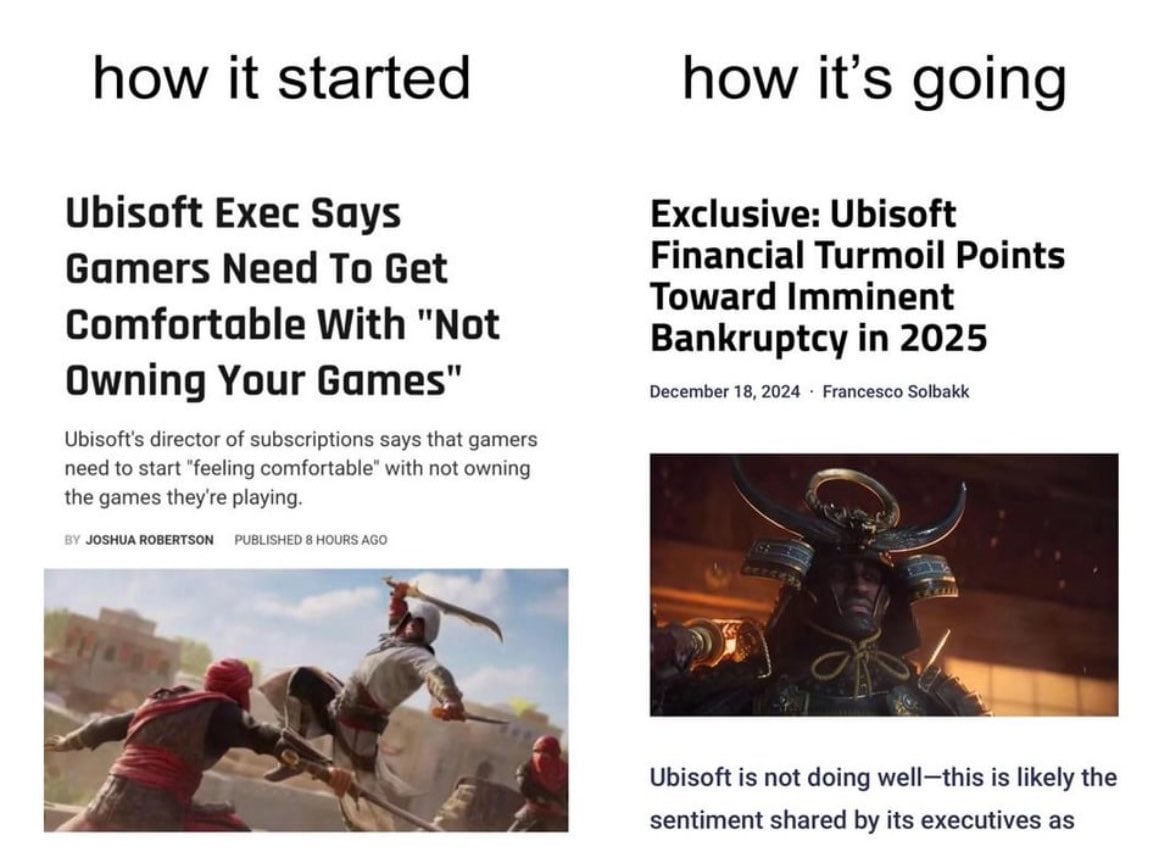
You’ve never owned your games. It’s always been a license to play the games. It’s just that now they have the ability to enforce it.
This is rather pedantic and obfuscates the reality and consumer rights. Don’t shill for big corp with that narrative, you could argue you don’t “own” a book either if we’re just doing silly talk in here.
Devil’s advocate: you obviously own the physical media that constitutes the book, but do you really “own” the contents of the book if you’re not allowed by law to make a million copies of it and sell them?
Who gives a fucking shit about this nonsense? I just want games I paid for to work after the developer stops supporting them.
Maybe you don’t, because you’re a moron.
I don’t think you should be calling other people “moron” if you don’t understand the phrase “devil’s advocate”.
First off, I only called them a moron on a condition, and I stand by my assessment.
Second, playing devil’s advocate is meant to enhance discussion. What they’re doing is muddying the discourse and playing into the hands of copyright-holders. It’s very close to the “just asking question” bullshit that’s so prevalent recently.
It was not like this back in the '90s. Games you purchased were on disk/disks. You installed the game and played the fully completed game that did not require an online connection. You owned that game.
After the Digital Millennium Copyright Act of 1998 things changed. So it has not always been like this.
You were still buying a license to play the games.
But you could trade them with your friends, so single license meant nothing. You owned the game.
I don’t think most people’s sense of “ownership” of a copy of a game has anything to do with whether or not they’ve legally bought a license.
For most of my collection, I own a physical thing, that represents the ability to play that game, using hardware I bought, whether I bought those things today, last year, or even a decade ago. Some of my games are digital, but I still have possession of a copy I bought, and can play it whenever I want. I paid money for the right to play a game when I want, and that’s a notion of ownership.
If someone can take it away from me, that isn’t aligned with my notion of ownership, and also isn’t worth spending money on imo. I own some GameCube games, and yes, technically that means I have a license, but they still work physically and legally. There’s nothing to enforce against me.
The thing that changed is the ability to revoke that license. And that amounts to a different concept than ownership. One not worth paying for.