Things have improved significantly in many areas since the 1970s, though challenges remain. Here are some notable ways the world is better today:
Technology and Connectivity
• Computing Power: Personal computers, smartphones, and the internet have revolutionized how we work, learn, and communicate.
• Global Connectivity: The internet allows instant communication and access to vast amounts of information, fostering collaboration and knowledge-sharing worldwide.
• Medical Technology: Advances like MRI, robotic surgery, and telemedicine have improved diagnosis, treatment, and access to healthcare.
Healthcare and Longevity
• Life Expectancy: Global life expectancy has increased due to advancements in medicine, vaccines, and public health initiatives.
• Disease Control: Eradication of smallpox and better treatments for diseases like HIV/AIDS and cancer have saved millions of lives.
Social Progress
• Civil Rights: Progress in gender equality, LGBTQ+ rights, and racial justice, although incomplete, has created more inclusive societies.
• Global Awareness: Social movements and the internet have made people more aware of human rights and environmental issues.
Education
• Access: Literacy rates have risen globally, and access to education has expanded, especially for girls and marginalized groups.
• Digital Learning: Online education and tools have made learning more accessible and diverse.
Economic Development
• Global Poverty Reduction: Extreme poverty rates have declined significantly due to economic growth and development programs.
• Global Trade: International trade and technology have created interconnected economies, raising living standards in many regions.
Environmental Awareness
• Clean Energy: Advancements in renewable energy technologies like solar and wind power offer cleaner alternatives to fossil fuels.
• Global Efforts: International agreements like the Paris Accord aim to address climate change collaboratively.
Quality of Life
• Convenience: Modern conveniences, from online shopping to ride-sharing apps, have simplified everyday life.
• Entertainment: Streaming services, gaming, and digital content have diversified entertainment options.
While these advancements have brought significant benefits, ongoing issues like climate change, inequality, and mental health need continued attention.
This is another benefit of the current age. I can have an AI quickly write responses to uninformed and narrowly defined statements. If any of that slop is untrue please let us know.
Did you ever walk down the street the 70s it was all cigarettes, leaded gasoline and diesel. So what if Paris accords failed. It is still much better now.
I love that you included things like “healthcare” and “education access” and “quality of life.”
Did you even look at the meme?
What a position of privilege you are in.
But sure. Lots of “environmental awareness.” Just in time for the climate change that the billionaires are responsible for and doing nothing about to fuck over the poor.
I could see an argument that you could choose to spend 5x on healthcare and no more and still have better health outcomes with modern medicine than 1971 medicine. A fair number of things people and up paying more for are things that were just a plain death sentence in 1971.
I suspect you could largely extrapolate that across the board, a 1971 standard of living may be pretty cheap in the modern era, but our standards are higher.
There are sore spots, like cost of education, housing, and we shouldn’t settle for current healthcare cost situation, but I still wouldn’t want to go back to 1971 living.
In 1971, there was a low-income subsidized housing program. Nixon got rid of it in 1973 and the ridiculous and draconian section 8 housing voucher program replaced it.
The real homelessness problem started then. It has ballooned more recently.
And I wouldn’t call that a sore spot. That really downplays the seriousness of it.
Sort of! Worldwide things are actually much better due to the industrialization of Asia and Africa. In the United States specifically things are worse. Both are valid discussions.

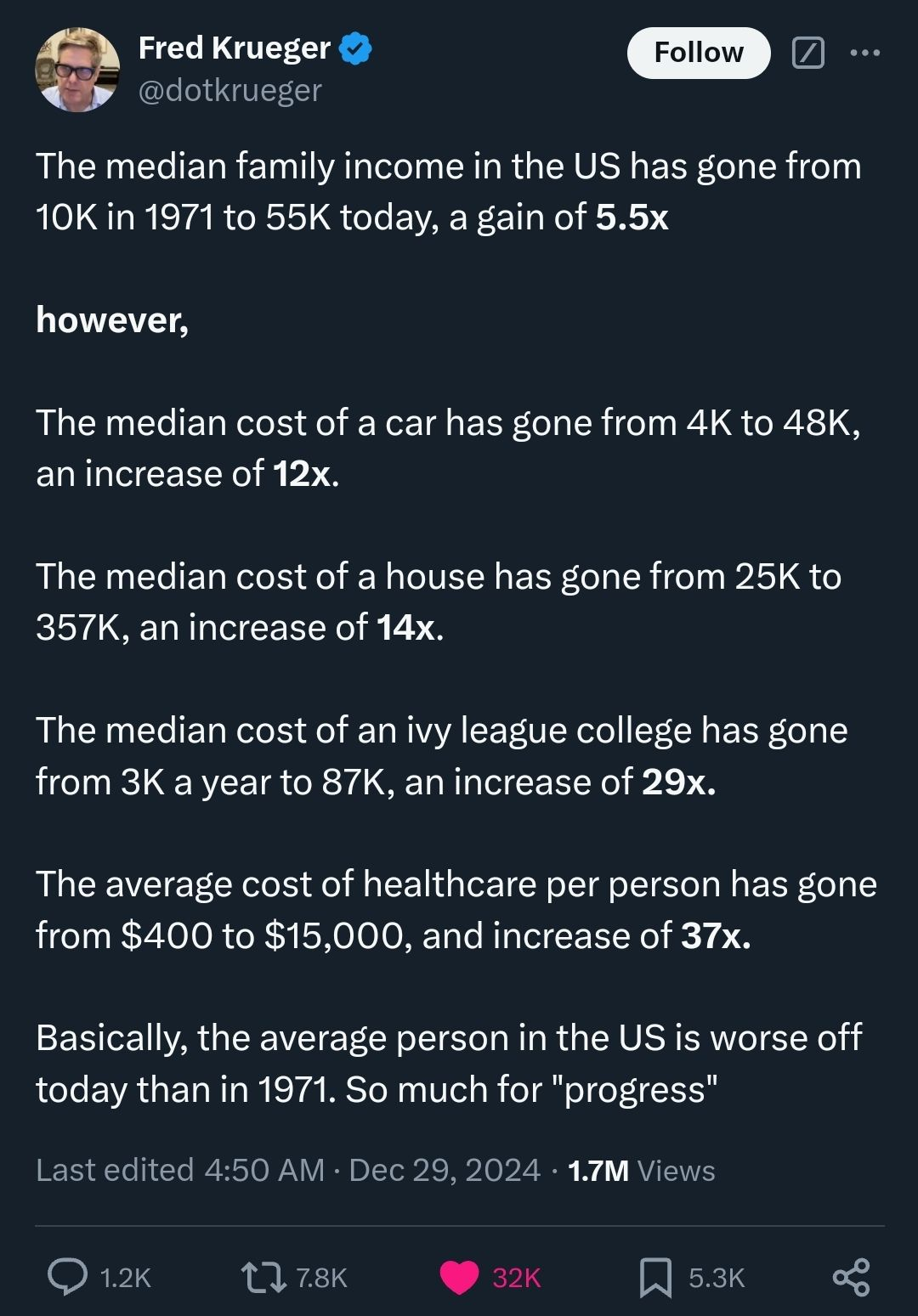
If you think we are not better off now than in the 70s, you have selective amnesia or possibly brain damage.
Who is “we” in this scenario? And better off in what way?
We are talking averages so the implication is everyone.
Again, better off in what way?
Things have improved significantly in many areas since the 1970s, though challenges remain. Here are some notable ways the world is better today:
Technology and Connectivity • Computing Power: Personal computers, smartphones, and the internet have revolutionized how we work, learn, and communicate. • Global Connectivity: The internet allows instant communication and access to vast amounts of information, fostering collaboration and knowledge-sharing worldwide. • Medical Technology: Advances like MRI, robotic surgery, and telemedicine have improved diagnosis, treatment, and access to healthcare.
Healthcare and Longevity • Life Expectancy: Global life expectancy has increased due to advancements in medicine, vaccines, and public health initiatives. • Disease Control: Eradication of smallpox and better treatments for diseases like HIV/AIDS and cancer have saved millions of lives.
Social Progress • Civil Rights: Progress in gender equality, LGBTQ+ rights, and racial justice, although incomplete, has created more inclusive societies. • Global Awareness: Social movements and the internet have made people more aware of human rights and environmental issues.
Education • Access: Literacy rates have risen globally, and access to education has expanded, especially for girls and marginalized groups. • Digital Learning: Online education and tools have made learning more accessible and diverse.
Economic Development • Global Poverty Reduction: Extreme poverty rates have declined significantly due to economic growth and development programs. • Global Trade: International trade and technology have created interconnected economies, raising living standards in many regions.
Environmental Awareness • Clean Energy: Advancements in renewable energy technologies like solar and wind power offer cleaner alternatives to fossil fuels. • Global Efforts: International agreements like the Paris Accord aim to address climate change collaboratively.
Quality of Life • Convenience: Modern conveniences, from online shopping to ride-sharing apps, have simplified everyday life. • Entertainment: Streaming services, gaming, and digital content have diversified entertainment options.
While these advancements have brought significant benefits, ongoing issues like climate change, inequality, and mental health need continued attention.
AI generated slop
This is another benefit of the current age. I can have an AI quickly write responses to uninformed and narrowly defined statements. If any of that slop is untrue please let us know.
Your AI touted the Paris Accords as a success.
https://www.politico.eu/article/paris-agreement-goals-failed-climate-change-global-warming-united-nations-climate-review/
Maybe best not to call other statements uninformed.
Did you ever walk down the street the 70s it was all cigarettes, leaded gasoline and diesel. So what if Paris accords failed. It is still much better now.
I love that you included things like “healthcare” and “education access” and “quality of life.”
Did you even look at the meme?
What a position of privilege you are in.
But sure. Lots of “environmental awareness.” Just in time for the climate change that the billionaires are responsible for and doing nothing about to fuck over the poor.
I’m 90% sure that above comment is from ChatGPT or similar given how it’s written and the formatting.
Yes it is.
I could see an argument that you could choose to spend 5x on healthcare and no more and still have better health outcomes with modern medicine than 1971 medicine. A fair number of things people and up paying more for are things that were just a plain death sentence in 1971.
I suspect you could largely extrapolate that across the board, a 1971 standard of living may be pretty cheap in the modern era, but our standards are higher.
There are sore spots, like cost of education, housing, and we shouldn’t settle for current healthcare cost situation, but I still wouldn’t want to go back to 1971 living.
In 1971, there was a low-income subsidized housing program. Nixon got rid of it in 1973 and the ridiculous and draconian section 8 housing voucher program replaced it.
The real homelessness problem started then. It has ballooned more recently.
And I wouldn’t call that a sore spot. That really downplays the seriousness of it.
Again everyone on average. I have no doubt your life sucks as much as you want to make your point. See now we can agree!
No, everyone in the U.S. on average.
This is not about my life, I’m not even going to be in the U.S. much longer.
Healthcare and higher education have become unaffordable in the U.S.
A quarter of American households live paycheck-to-paycheck.
https://www.cbsnews.com/news/paycheck-to-paycheck-definition/
The average American is over $100,000 in debt.
https://www.fool.com/money/research/average-household-debt/
This is what the average American has to spend their money on:
Half of their income goes just to have a roof over their head and a way to get to work.
And you think the quality of life here is so great? Ask the average person when the last time they had a real vacation was.
What does that chart look like in the 70s?
Sort of! Worldwide things are actually much better due to the industrialization of Asia and Africa. In the United States specifically things are worse. Both are valid discussions.
alive > not alive
So I’m better off