The Meissner's
  • Communities
  • Create Post
  • Create Community
  • heart
    Support Lemmy
  • search
    Search
  • Login
  • Sign Up
PugJesus@lemmy.worldM to Historical Artifacts@lemmy.worldEnglish · 11 months ago

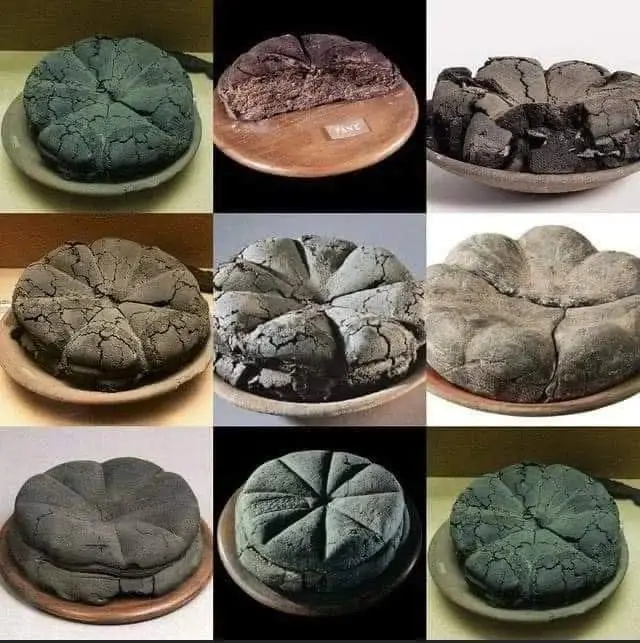
Bread (semi)-preserved by the eruption of Mount Vesuvius, Italy, 79 AD

lemmy.world

external-link
message-square
9
fedilink
69
external-link

Bread (semi)-preserved by the eruption of Mount Vesuvius, Italy, 79 AD

lemmy.world

PugJesus@lemmy.worldM to Historical Artifacts@lemmy.worldEnglish · 11 months ago
message-square
9
fedilink
alert-triangle
You must log in or register to comment.
  • PugJesus@lemmy.worldOPM
    link
    fedilink
    English
    arrow-up
    9
    ·
    11 months ago

    https://diningandcooking.com/687253/ancient-loaves-of-bread-from-the-cities-of-pompeii-and-herculaneum-that-were-carbonized-in-volcanic-pyroclastic-flows-of-mount-vesuvius-in-79-ad/

    Pretty sure they aren’t edible, but they provide a glimpse into how Roman bread looked!

  • disguy_ovahea@lemmy.world
    link
    fedilink
    English
    arrow-up
    8
    ·
    11 months ago

    Bread that won’t burn in the toaster! God the Romans were clever.

  • 2ugly2live@lemmy.world
    link
    fedilink
    English
    arrow-up
    5
    ·
    11 months ago

    This shit is so cool. I love when they show us little mundane items. Bread, tools, games, etc.

  • Treczoks@lemmy.world
    link
    fedilink
    English
    arrow-up
    4
    ·
    11 months ago

    Amazing how they all look alike.

    Probably all of the same size/weight, too, as bread was an important part of the daily food, and was regulated as hell. Imagine the punishments for the baker who made bread too light or with cheaper ingredients! At some times in history, bakers were even executed for adding sawdust or other “fillers”.

    • PugJesus@lemmy.worldOPM
      link
      fedilink
      English
      arrow-up
      4
      ·
      11 months ago

      Roman bakeries used unique stamps, so each one could be traced back to its bakery of origin - and falsification of weight or ingredients could be punished quite harshly - up to a sentence in the mines, which, even for a short stint in the mines, was effectively a death sentence.

      • tedd_deireadh@lemmy.world
        link
        fedilink
        English
        arrow-up
        2
        ·
        11 months ago

        Does the bread in the bottom middle have that stamp on top? It’s hard to make out but looks like a man-made marking.

        • PugJesus@lemmy.worldOPM
          link
          fedilink
          English
          arrow-up
          3
          ·
          edit-2
          11 months ago

          It looks about right, resembles this example

          • tedd_deireadh@lemmy.world
            link
            fedilink
            English
            arrow-up
            2
            ·
            11 months ago

            Fascinating! Thanks for including the reference. It’s almost unbelievable that marking food goes back so far. I assumed that was a relatively recent development.

            • PugJesus@lemmy.worldOPM
              link
              fedilink
              English
              arrow-up
              1
              ·
              edit-2
              11 months ago

              The Romans were very innovative in the field of commerce! Stamping other goods with their workshop of origin was also common, sometimes with both a stamp for the name and for the ‘symbol’, to make it more distinct! We can trace a lot of goods in distant provinces to the other side of the Empire for that reason, with even things like (relatively) cheap plates and cups being lost in Britain, but made in North Africa or Syria!


Historical Artifacts@lemmy.world

historyartifacts@lemmy.world

Subscribe from Remote Instance

Create a post
You are not logged in. However you can subscribe from another Fediverse account, for example Lemmy or Mastodon. To do this, paste the following into the search field of your instance: !historyartifacts@lemmy.world

Just a community for everyone to share artifacts, reconstructions, or replicas for the historically-inclined to admire!

Generally, an artifact should be 100+ years old, but this is a flexible requirement if you find something rare and suitably linked to an era of history, not a strict rule. Anything over 100 is fair game regardless of rarity.

Generally speaking, ruins should go to !historyruins@lemmy.world

Illustrations of the past should go to !historyillustrations@lemmy.world

Photos of the past should go to !HistoryPorn@lemmy.world

Visibility: Public
globe

This community can be federated to other instances and be posted/commented in by their users.

  • 26 users / day
  • 26 users / week
  • 59 users / month
  • 9 users / 6 months
  • 0 local subscribers
  • 692 subscribers
  • 190 Posts
  • 361 Comments
  • Modlog
  • mods:
  • PugJesus@lemmy.world
  • BE: 0.19.9
  • Modlog
  • Instances
  • Docs
  • Code
  • join-lemmy.org