ꌗꉓꃅ꒒ꍟꀎ𝔻ꍟℜ𝕊𝕋𝕌ℝℤ
South African, living in Germany, left-leaning, deeply aligned with the opening lines of the Grundgesetz that declare all people to have inherent worth. Nerdy of nature and short of stature, I bend code and words to my purposes yet revel in my sports and thrive in the hills and high places.
- 9 Posts
- 11 Comments
Joined 1 year ago
Cake day: December 2nd, 2024
You are not logged in. If you use a Fediverse account that is able to follow users, you can follow this user.



 3·1 year ago
It’s a good question for the package maintainers.
In their defence: it isn’t a direct dependency, it isn’t advertised, and it is likely that the distro package maintainers just don’t know about it – Electron hardly announce that they chose to depend on something that they know isn’t released, anywhere, yet, and won’t be for months.
To lighten the mood, here’s a screenshot of one of the lowest points I achieved while hacking away, trying to resolve the issue:
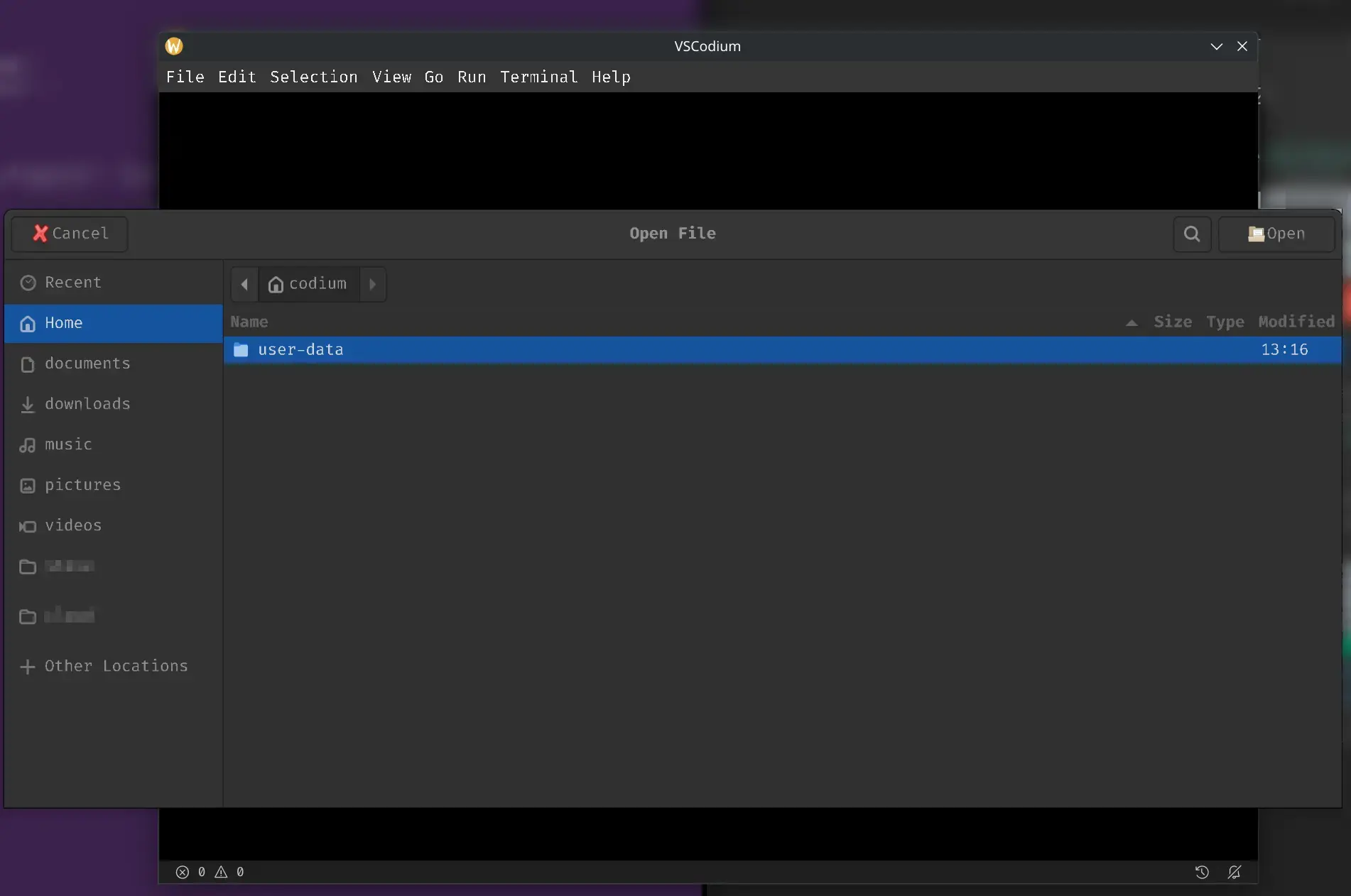 What even is going on, there?
- pixelated menu
- “Cancel” button at the top left??
- “Open” button at the top right??
- clearly Adwaita but not actually Adwaita as configured – the VSCodium window (behind) shows how Adwaita is actually configured on my system and that’s how all native gtk applications actually draw.
 2·1 year ago
I found this through other means[1] and appreciated it. It introduced new ideas to me while also describing a lot of things that resonate with me, personally, in words that I wouldn’t have strung together, myself.
In summary, the argument it makes is that “inclusivity” in games is performative at best and, nearly always, just a token gesture that looks good on the tin and gets praised by the mainstream press but is always implemented in a way that is aimed squarely at cis-het. male players.
One of the strongest examples used to support this is how female player-characters are usually intended to be characters that the player observes, like a voyeur, in the second-person, and player-characters which are intended for the player to identify with and project themselves into are invariably cis-het. males. Lara Croft vs Geralt.
I’m intending to watch it through, again, soon and it might not stand up to the scrutiny of a second, more critical viewing but I certainly found it thought-provoking on round 1.
I’d love to hear other opinions on the video’s arguments, though.
Unbelievably, 'twas the YT Algorithm. Is it because I block ads? Perhaps YT has truly given up all hope of brain-washing me and just fallen back on giving me more of what I want[2] like a parent tired of a child’s nagging? Is this some kind of gas-lighting initiative? Are Alphabet actually not that evil? ↩︎
Kinda wish the creator didn’t have to skirt around “acceptable content” policies to survive YT, though. While watching it, I felt their frustration at needing to self-censor coming through and it did threaten to frustrate their argument. ↩︎
Taiga is too broad. I tried it out with all the best intentions and, quite simply, it is too big. It is too complex and complicated and feels extremely heavy to use.
From decades of professional experience, I know that all forms of planning are performed breadth-first and not depth-first. One jots down a bunch of titles or concepts and delves into them, fleshing them out and adding layers of detail afterwards. Taiga just doesn’t seem to facilitate that workflow.
It is focussed on fixed ideas like “epics” and “user-stories” and its workflow needs one to understand how your planning should fit into those boxes. I never work like that: I don’t know whether a line-item on a scrap of paper is an “epic” or a “story” or just destined to be an item in a bulleted list, somewhere within something else. I don’t want to have to choose what level of the plan the line-item fits before I capture it in my project tracker – I just want to type it up, somewhere, and be able to move it around or promote it or add stuff to it or whatever, later.
In summary: Taiga seems “fine” but just isn’t for me.
 1·1 year ago
I think I’m in agreement. I’m also inspired by Cory Doctorow’s recent piece in which he talks about how his blog – pluralistic.net – is ascetic: basically just a static site that spreads through other channels.
Hugo seems ok for this, I’m thinking, along with just about any static site hosting and my own domain name.
Moving into the new year, I’m going to actually do this properly but one key objective is this: I am determined only to write properly on positive topics, creativity, passion, delight and inspiration and to ignore all the hate and the destroyers and the bad stuff.
The TL;DR of my thesis is basically this: I only wish to write about topics I think are worthy of being read and, for me, any work is only worthy if the reader actually stands some slight chance to gain something from ingesting it.
I’m very nearly 40 years old, recently a father, unemployed, burned-out, and of such a confusing string of nationalities that I don’t get to vote anywhere in the world despite having worked and paid taxes in three countries on three distinct continents, all of which are supposedly “democracies”. As a reader, I can do little against the haters and the destroyers and the plutocrats and I need learn nothing new to recognise them and see them for what they are. As a reader, then, I get no worth from reading more assessments of the “bad”, neither is there any shortage of scriveners far more informed and skilled than I who write about that bad. As a writer, I am only interested in writing about the “good”: things that other readers can actually derive value from ingesting.
That said, I know I need an outlet to vent in and I know I need another space to experiment in. I don’t mind if the “proper” journal and the free-association style blog become unofficially associated with each other for much the same reasons why I don’t mind when my personal stuff and my open-source contributions signed under my real-life name get associated: I’ve nothing to hide. (I choose to live in the world I wish existed: a world in which I need not hide.)
But I don’t want them to be too easily linked because that sort of thing becomes a career limiting move simply because dumb algorithms will readily cancel one’s professional profile long before any actual human ever sees one’s job application or C.V. in a real-life setting.
I’m thinking I’ll use the WriteFreely space as the sand-box and do the real essays, properly, with something like Hugo.
I also am a huge fan of personal pages and wish to see their return. Would you join a web-ring with me?
 5·1 year ago
I guess the KDE team just triggered my “see red” response. I saw an unfamiliar notification and immediately went on the offensive because of how often attention-stealing and attention abuses in general are exploited by bad actors.
I know the concept of startle-training very well. It has, in fact, been part of my training for certain volunteer roles that were carried out in stressful, objectively dangerous and high-risk scenarios but those were all In Real Life. They were all for a cause in which I believed – I volunteered to be there.
It is precisely so I have patience and resilience to handle those In Real Life scenarios that I so jealously guard my attention when I don’t judge that frittering it away on silly annoyances is warranted.
I put
INSTALL_MASKadditions into files in/etc/portage/env/and then associate those files with packages via/etc/portage/package.env/. One can discover which package a file belongs to withequery b. Once that package has apackage.enventry that applies anINSTALL_MASK, manually delete the unwanted file and runemerge -1to re-emerge it, then double-check that the file was not restored.
If you – like me – run Gentoo and have a working knowledge of Portage, you can configure it not to install the KDED modules that provide the donation popup thusly:
INSTALL_MASK="/usr/share/knotifications6/donationmessage.notifyrc /usr/lib64/qt6/plugins/kf6/kded/donationmessage.so"Even without the nag popup, one might still donate: https://kde.org/donate/
Ok. I’ve been trying out WriteFreely and, yeah, here: https://personaljournal.ca/schleudersturz/it-is-more-important-to-flaunt-our-humanity-today-than-it-ever-was-before
How does it look?
- I really like the simplicity of it.
- I do not like how hard it was to discover a seemingly appropriate host.
- I never worked out how drafts were supposed to work and this post was just published without drafting or without any way to preview it or test whether it came out with the right formatting.
- At least one taxonomy would be good: single-level categories, at a minimum.
Maybe some of the features I want are actually there and I’ll find them, eventually.
I’m thinking to try Taiga, next, but not today. Their pricing page doesn’t seem to indicate that self-hosted instances will be limited and there are other overtly positive signs on their site, too.
Self-hosting is an option they openly promote on the landing page. If you use
ctrl+fto search forself-host, you immediately find a link to documentation on how to do that.Has anyone any experience of Taiga? Horror stories? (Save me time!) Or good recommendations are also welcome.
Zed is very interesting. I know it.
Very recently, I found a fork of Zed that gutted the AI Assistant integration and Telemetry. I forked that, myself, and took it further: gutting automatic updates, paid feature-gating, downloading of executable binaries and runtimes like Node.js (for extensions that don’t compile to WASI), integration with their online services, voice-calling, screen sharing, etc.
My branch ended up down 140 000 lines[1] of code and up less than 300! It was educational and the outcome was absolutely brilliant, to be fair. In all honesty, forking it and engaging in this experiment took less than 24 hours even though I restarted three times, with different levels of “stringency” in my quest.
This experiment was very realisable. Forking Zed and hacking on it was quite possible – the same cannot be said for just “forking Electron” or “forking VS Code” or even getting up to speed on those projects to the point of being able to fix the underlying issues (like this OP) and submit merge-requests to those projects. They have a degree of inscrutability that I absolutely could overcome but would not, unless I was paid to at my usual rates. (I have two decades of professional development experience.)
I shelved the effort – for the time being – for a few reasons I don’t particularly want to extenuate, today, but I shall continue to follow Zed very closely and I truly, deeply hope that there is a future in which I see hope (and, thus, motivation) in maintaining a ready-to-go, batteries-included, AI-free, telemetry-free, cloud-free fork.
Part of maintaining a fork would include sending merge-requests upstream even though I should hardly expect that my fork would be viewed favourably by the Zed business. But, from what I can tell, Zed seem to act true to the open-source principles – unlike many other corporate owners of open-source projects – and I see no reason (yet) to believe they would play unfairly.
No word of a lie! The upstream repo is well over 20k commits and over 100 MB in volume. Zed is not a nice, small, simple code-base: it is VAST and a huge percentage of that is simply uninteresting to me. ↩︎